
Cedar Falls Past Resident Sources
A backward address trail has two tracks. Title records identify people who held an interest in the land. Household records may identify someone listed at the site. Do not treat an owner as an occupant without a second source. Start with the present PIN and legal description, then choose the source that reaches the period in question.
| Source | Time span | Where held | What it shows |
|---|---|---|---|
| Recorder AVA | Online start not verified | Black Hawk County Recorder | Indexed deeds and related land instruments |
| Transfer books | Searchable back to 1868 | County Auditor, ArcaSearch | Transfers by subdivision or land description |
| City directories | Exact nonannual years, 1874 to 2014 | Cedar Falls Historical Society | Published names, addresses, and descriptors |
| Telephone directories | Exact nonannual years, 1917 to 1959 | Cedar Falls Historical Society | Telephone listings useful in city-directory gaps |
| Land transfer archive | Lands 1866 to 1988; town lots 1880 to 1988 | State Historical Society | Archival transfer series |
| Sanborn map | 1909, sixteen sheets | Library of Congress | Historic building and street context |
The society also holds photographs, postcards, family papers, yearbooks, probate, cemetery, marriage, death, and audiovisual material. Its archives are available by appointment, or staff can research a question. Fees may apply, but no fixed research-fee schedule was published.
Trace Black Hawk Deeds Backward
Begin in the Cedar Falls Property Viewer. Save the PIN, subdivision, lot and block if shown, legal description, and current deed-holder spelling. Next open the Recorder’s AVA land index. Search the current holder as a grantee and compare the deed’s legal description with the parcel. The street number alone is weak because an older instrument may omit it or use another unit notation.
- Record the present parcel identity and holder from GIS, without assuming that the holder lives there.
- Find the current acquisition deed. Capture its instrument number, date, grantor, grantee, legal description, and return address.
- Search that grantor as an earlier grantee, keeping the same legal description in view.
- Repeat each supported transfer. Separate deeds from mortgages, releases, easements, assignments, liens, and plats.
- When AVA stops, contact the Recorder and use the county transfer books or the State Historical Society series.
The Black Hawk County Recorder is at 316 E 5th Street, Room 208, Waterloo, not Cedar Falls. The phone is 319-833-3012. Online coverage and image fees were not established by the official pages, so do not invent a start year or assume that the first online hit is the first deed.
Cedar Falls Deed Trail Terms
A few plain definitions keep previous residents research accurate when the title trail crosses portals and handwritten books.
- Grantor
- The party giving or transferring an interest in the recorded instrument.
- Grantee
- The party receiving the interest.
- Chain of title
- The linked sequence of supported transfers for the same land.
- Legal description
- The lot, block, subdivision, or section-based description used to identify land in records.
- Criss-cross directory
- A directory arranged by street and number, useful for finding a listed occupant when the name is unknown.
A deed transfers an interest. It does not itself tell who slept in the home. A return address can be useful, but it may belong to a party, attorney, lender, or later mailing destination. Mark each conclusion as ownership, listing, or occupancy evidence instead of blending the categories.
Cedar Falls Transfers Reach 1868
Black Hawk County’s scanned transfer books create an older parallel path. The searchable ArcaSearch set reaches back to 1868 and can be searched by subdivision or by section, township, and range for unplatted land. A preservation project announced in November 2024 supported access to books at risk from age, handling, theft, fire, or disaster. That preservation story does not mean a courthouse fire destroyed Cedar Falls records.
The Recorder’s AVA page is the official entry for the modern online index.
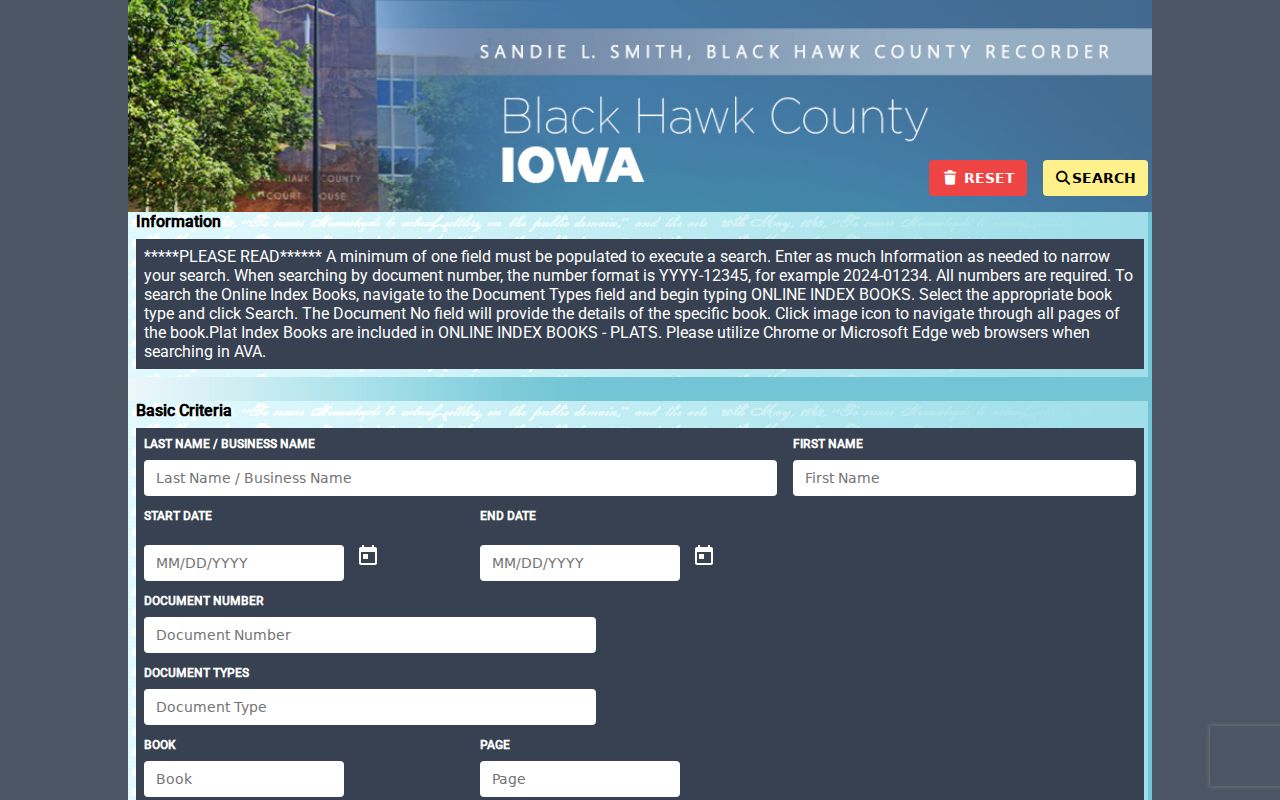
The captured page confirms the portal route, but not its oldest online year or any image fee.
State Historical Society holdings extend the context. Its Black Hawk County series lists land transfers from 1866 through 1988 and town-lot transfers from 1880 through 1988. These dates describe series spans, not a promise that every expected instrument image is online. If a past residents trail crosses a plat boundary or an unplatted tract, ask which volume and page supplied the entry and preserve the citation.
Cedar Falls Previous Residents by Year
The Cedar Falls Historical Society’s long directory shelf is nonannual. Listed city-directory years begin in 1874 and end in 2014. Telephone volumes run from 1917 through 1959. This makes the collection strong but uneven. Gaps such as 1997 through 1999, 2001, 2006 through 2009, and 2012 cannot be read as years when a person was absent.
Search a known surname in an alphabetical section and copy the exact spelling, initials, spouse notation, address, descriptor, year, page, and volume title. When the name is unknown, ask whether the volume has a street or address section. Move through the nearest listed years, not assumed annual steps. The Cedar Falls city directory collection has the exact runs and reading method. Here, each entry serves the single-address timeline.
Waterloo city books and Black Hawk County telephone books can provide nearby context, but a Waterloo or county listing is not proof of a Cedar Falls address. Publisher metadata was not stated on the holdings page. Read it from a volume’s title page instead of guessing.
Pair Cedar Falls Directories and Census
Federal census schedules can reveal a household that ownership records miss, subject to the federal 72-year access rule. Check the official National Archives release information before stating the newest public year. Do not project a historical household into the present. Pairing works best when the directory’s publication date and the census enumeration date are both known.
- Choose the closest listed Cedar Falls directory before the census date and record the address exactly.
- Check the closest directory after that date for a change in name, initials, spouse notation, or number.
- Search the census by name and location, then compare household members without assuming identical spelling.
- If the number differs, bridge the parcel with the street index, plat, Sanborn sheet, deed, or permit date.
- Cite each source separately. A directory listing and census household are two records, even when they agree.
Telephone books can fill some directory gaps, while yearbooks, family papers, cemetery records, and photographs may resolve a name variant. The Historical Society accepts detailed research requests. Supply the address, approximate years, spelling variants, desired record type, and whether a copy or citation is needed.
Map an Older Cedar Falls House
The Library of Congress holds a February 1909 Cedar Falls Sanborn fire-insurance map in sixteen sheets. Match its street and sheet context to the city Street Name Index and current parcel layers. County historical aerial records add views for 1941, 1964, and 1979. Together, these can show that a building footprint or street setting changed.
A historic map does not identify all previous residents, and its footprint is not a current legal boundary. Use it to ask better questions: Was a building present? Did the street label differ? Does the lot correspond to today’s legal description? Then test the answer against deeds, plats, directories, and permits. No verified citywide renumbering or renaming timeline was found, so any claimed change year needs direct support from Planning, GIS, or the source record.
Cedar Falls Address Change Records
Building permits can date construction, an addition, demolition, or occupancy-change paperwork. The Cedar Falls Maps page links the Open Building Permits dashboard, and CF1Stop provides permit entry points. A complete historic permit table and its cutoff were not verified. Search the public systems first, then send a narrow request through the city Open Public Records form.
Ask for an existing record tied to a house number, street, date range, and permit type. City requests may be made electronically, in person, in writing, or by phone under Iowa Code chapter 22. The city need not create a new history that does not exist. A dated permit can explain a change in the building, but the applicant or owner field is not by itself proof of a resident.
Cedar Falls Household Trail Endpoints
When a name vanishes from a directory, search the society’s probate, marriage, death, cemetery, family-paper, photograph, postcard, and yearbook holdings. Cedar Falls also has a city cemetery search. The State Historical Society lists a Cedar Falls cemetery series for 1928 through 1938. Coverage controls for the current dynamic cemetery lookup were not documented, so capture only fields the result actually displays.
No complete official Cedar Falls obituary index or newspaper microfilm run was verified. Ask the Public Library or Historical Society what is available before promising a date span. An obituary, probate file, or cemetery entry may explain death, kin, or estate activity, yet it may not state that the person remained at the researched address. Keep it as an endpoint supported by its own text.
Cedar Falls Previous Resident Limits
Previous residents can be traced for house history, genealogy, estate work, and personal curiosity. A strong timeline labels title holders, published directory listings, census household evidence, and building events as separate findings. Safe at Home, sealed court matters, confidential vital records, restricted vehicle data, and other legal limits may create intentional gaps.
Use the trail with care. Never use Cedar Falls address history to track, stalk, harass, intimidate, or harm a living person.
The absence of a name does not prove absence from the home. A person may not have owned property, had a telephone listing, appeared under the expected spelling, or fallen within a surviving volume. Close the trail only as far as the evidence supports, and verify copies and citations with the Recorder, archive, library, or society that holds them.