
Cedar Falls Directory Holdings
The Cedar Falls Historical Society holdings list is the best verified inventory. Its Cedar Falls city directories start in 1874 and end in 2014, but the run is not annual. The Society does not identify a publisher for every book. Read each volume's title page before assigning a publisher or treating one book's abbreviations as universal.
| Collection | Years represented | Where held | Access |
|---|---|---|---|
| Cedar Falls city directories | 1874 to 2014, nonannual | Cedar Falls Historical Society | Appointment or staff research |
| Cedar Falls telephone directories | 1917 to 1959, selected years | Historical Society | Appointment or staff research |
| Waterloo city directories | 1920 to 1996, selected years | Historical Society | Nearby cross-check |
| Black Hawk County telephone books | 1916 to 1968, selected years | Historical Society | Appointment or staff research |
| County name-bearing series | 1853 onward, varies | State Historical Society | Archival finding aid |
The list confirms holdings, not a digitized name index. An online search may stop at the collection description. That is the cue to contact the archive, not proof that a person has no listing.
Cedar Falls Directory Years
The run includes 1874; 1894; 1897-98; 1901-02; 1909-10; 1913; 1915; 1919; 1923; 1927; 1934; 1945; 1948; 1950; 1954; 1956-57; 1959; most listed years from 1961 through 1979; many years in the 1980s and 1990s; and selected volumes through 2014. This span is one of Cedar Falls' strongest genealogy tools.
Yet absence must be read with care. There are no listed city directories for 1997-99, 2001, 2006-09, or 2012. Earlier decades have wider gaps. A missing name may reflect the shelf gap, an initial or spelling variant, a move between Cedar Falls and Waterloo, or publication rules. It cannot establish that someone had left town.
Cedar Falls Telephone Cross-Checks
Telephone volumes overlap some gaps but answer a narrower question. The verified Cedar Falls list begins in 1917 and includes selected years through 1959. A phone book may identify a subscriber, street address, business, or institution. It may omit other adults in the home and anyone without a listed line.
Waterloo city books and Black Hawk County telephone books add a nearby check. Waterloo is the county seat and is close, but a Waterloo listing is not proof of a Cedar Falls address. Record the printed city label and street exactly. Use the book to test a move or spelling, then return to a source tied to the correct place.
Accessing Cedar Falls History
The Historical Society research service offers archive access by appointment and staff research. The Society is at 308 West 3rd Street in Cedar Falls and can be reached at 319-266-5149. Fees may apply, though no fixed schedule is published. A focused request should include name variants, an address, a date range, record type, and whether a copy or citation is needed.
Ask which volume, year, page, and shelf identifier supplied the result. Also ask whether permission is needed to reproduce an image. The collection extends beyond directories to photographs, postcards, family papers, yearbooks, cemetery records, probate, marriage and death material, and recordings.
The Cedar Falls Public Library local-history gateway points to the Society, city cemetery search, Fortepan Iowa, and Historical Cedar Falls. Its page does not state exact newspaper microfilm years or a current obituary index. Call 319-268-5543 to ask what is available.
The image below comes from the Society's holdings page.
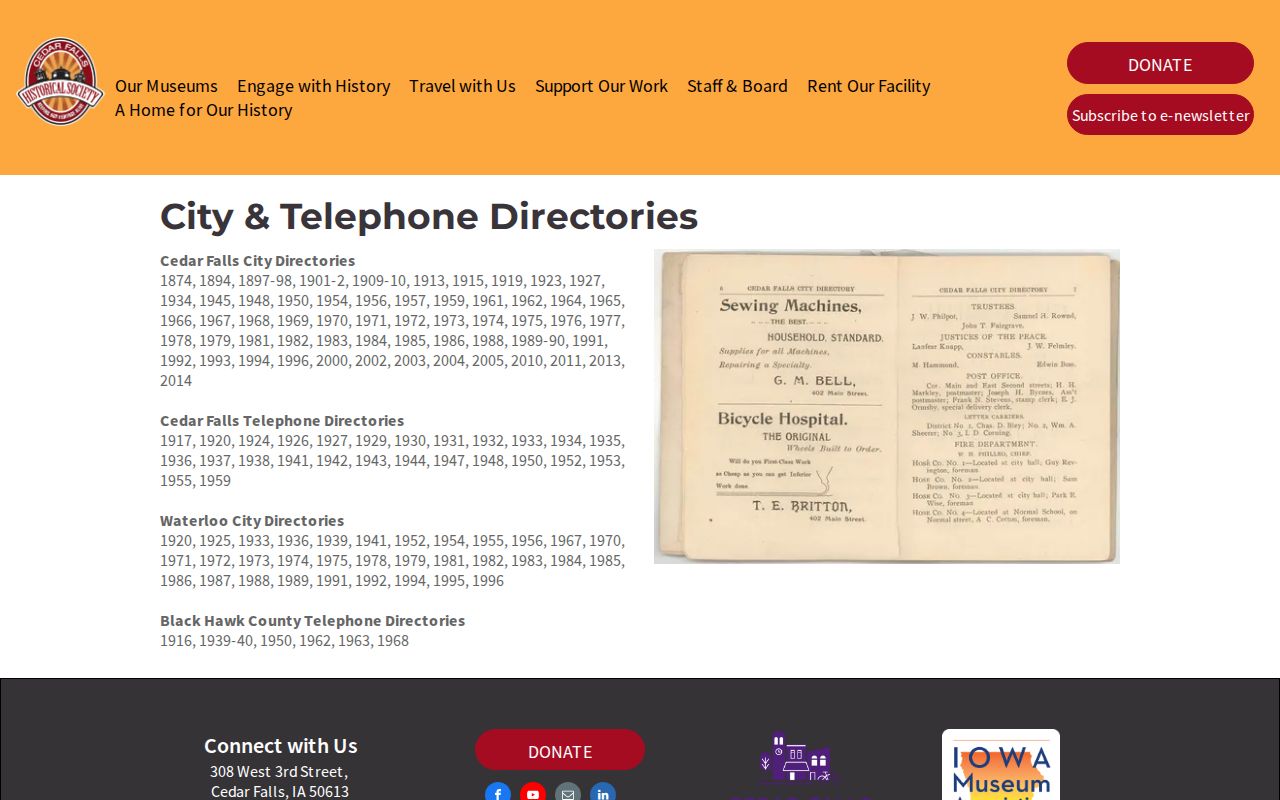
It shows why checking each year matters: local, Waterloo, telephone, and county runs overlap but do not form one continuous sequence.
Read Cedar Falls Directory Entries
Begin with the volume's own instructions. A typical alphabetical entry may show initials, spouse notation, a descriptor, street and number, a cross-reference, and a business or institution. Later street sections may group occupants beneath an address. Marks for residence, boarding, ownership, or widowhood can change by year and publisher, so never decode them from memory.
| Name | Copy initials, spelling, and household notation exactly. |
|---|---|
| Descriptor | May identify a trade, business, institution, or label used in that volume. |
| Address | Preserve number, street spelling, unit, and cross-reference. |
| Source | Record title, year, page, and shelf identifier. |
- Criss-cross directory
- A street-order section that starts with an address rather than a surname.
- Householder index
- An index organized around the named person tied to a household.
- Abbreviation key
- The volume's legend for shortened words and marks. Copy it before interpreting entries.
Trace Cedar Falls Families
A city directory can bridge the years between other records. Work in short, documented steps, since a publication year may not match the exact date when data was gathered.
- Search the surname and likely initials in the closest listed year.
- Copy the entry, spouse notation, descriptor, address, page, and title.
- Move to the nearest earlier and later listed books. Do not assume an annual run.
- When the surname fails, use the street-order section or telephone book to hold the address constant.
- Compare the result with a census, cemetery record, deed, or another independent source.
For modern parcel work, the Cedar Falls street directory explains the address-keyed chain. An old address may predate ZIP codes. Preserve what the book prints before bridging it to a modern parcel.
Cedar Falls Directory Timeline
The local shelf covers far more than a century, while companion county series reach into the city's earliest organized years.
| Date | Research marker |
|---|---|
| 1853 | Black Hawk County was organized, and Cedar Falls was initially selected as county seat. |
| 1855 | The seat moved to Waterloo, where county offices remain. |
| 1874 | First Cedar Falls city directory listed by the Society. |
| 1917 | First listed Cedar Falls telephone directory. |
| 2014 | Last city directory shown in the published holdings list. |
These dates mark listed volumes, not the start or end of all local records. No verified source names every publisher or confirms why each gap exists.
Cedar Falls Archive Companions
When a listing vanishes, switch record types. The State Historical Society's Black Hawk County finding aid lists naturalization declarations from 1855 to 1940 and an index from 1853 to 1906. It also identifies Cedar Falls cemetery records for 1928-38, land transfers, and early county court material. A finding aid describes holdings; it does not mean all pages are online.
The city cemetery search may add an interment clue, while yearbooks can help with a school-era name. Family papers and photos may explain a shared address. The Library of Congress also has a public-domain, 16-sheet Cedar Falls Sanborn map from 1909. Keep citations separate and do not turn a directory inference into a proven life event.
Cedar Falls Directory Limits
Historical directories were edited products. They did not list every person, and rules changed between editions. A telephone book centers subscribers. An alphabetical entry may center one named householder. A street section may lag a move. None is a complete modern roll.
Household composition also requires care. A spouse notation may reflect the publisher's format, while another adult at the same Cedar Falls address may receive no alphabetical entry. Business and institution entries can share names with individuals. Compare page context, the printed key, and at least one independent source before joining two records to the same person.
Use these city directories for lawful family, local, and property history. Respect reproduction rules and living people's privacy. Confirm a key fact through an independent record, and state uncertainty when only one source supports it. If staff supplies the answer, retain the request date and archive citation so another researcher can repeat the Cedar Falls search.